

The money isn’t yours.
This is the one sentence I wish I’d heard when my philanthropy journey began in 2013.
Back then, “strategic philanthropy” was the hot trend, thanks in large part to the publication of a seminal book on the subject: Money Well Spent: A Strategic Plan for Smart Philanthropy (Brest & Harvey, 2008). The cohort program I attended at The Philanthropy Workshop West (now Forward Global) that year taught me that my giving should be driven by my passion. My personal connection to an issue, they extolled, would sustain my commitment for the long term. This made sense: When challenges arose or efforts felt futile, I could dip into a reserve of passion to stay the course. And if enough donors followed suit, more money would ultimately flow in a more sustained fashion over a longer-term. The tools and practices we learned in the nine-month program and the capstone theory of change we presented all centered this passion. Cohort members focused their energy on topics such as Type-1 Diabetes, local public health systems, and social entrepreneurship. After a grueling monthslong soul-search for a passion, I chose documentary film.
The funds at my disposal to deploy had already been deposited into my donor-advised fund as an inheritance disbursement following the death of my father in May, 2013. The tax deduction had already been taken, and I could not pull the money out to spend on myself. I could, however, allocate the resources to any 501c3 of my choosing on whatever timeline suited me; or never, since there is no mandate to spend DAF funds at all.
Don’t worry! I’ve spent it. I happen to be one of those DAF-holders with (some?) ethics, who from the start viewed the account as a temporary waiting room for money to quickly find new homes in the nonprofit sector. I made spending it my job, and I went all-in. Where did it all go? Broadly-speaking, twenty-five-ish documentary shorts and features, a handful of artist support/regranting/ecosystem nonprofits, a couple film festivals, the Dear Producer Award, and the Forever Roxie campaign. I do not regret for one second any of this expenditure. In fact, I’ve been a vociferous champion of grants for documentary film, especially for the kind of films the market alone wouldn’t resource. Though I am deeply uncomfortable tooting my own horn, I think it’s fair to say that there are films in the world, filmmakers with careers and community, audiences reached, and institutions sustained thanks to the checks I wrote. I’m really proud of this legacy, and even more grateful for the learning and relationships my funder work brought into my life.
But never, not once in these twelve years, did I entertain the notion that there might be a problem with me making all the decisions; that, even though the DAF account had my name on it, the money wasn’t actually mine. Why would I have? Ours is a donor-centric society, with funder perks, promises of exclusive access, and grantee-funder power dynamics that reinforce the donor-centrism I cultivated back in my TPWW cohort. With the benefit of hindsight, I also now recognize the breathtaking degree of privilege of my approach, the kind that often comes with being the Only Daughter of a Very Successful White American Male. I followed my passion, developed all the strategies, chose all the grantees, and accumulated all the EP credits.
Completing the TPWW program in mid-2014 didn’t signal the end of my philanthropy learning; rather, it was just the beginning. Cataclysmic global and national events — the election of Donald Trump, twice; COVID-19; the national unrest of the summer of 2020; the widening income gap and stratospheric wealth accumulation among the super elite – shone a brighter spotlight on philanthropy and how it was, or wasn’t, “meeting the moment.” The books Winners Take All: The Elite Charade of Changing the World by Anand Giridharadas and Edgar Villanueva’s Decolonizing Wealth: Indigenous Wisdom to Heal Divides and Restore Balance burst onto the scene in 2018, exposing the ways in which philanthropy mirrors our society’s inequities more than combats them. I discovered Vu Le’s blog, Nonprofit AF, a no-holds-barred and often hilarious sendup of the Philanthropic Industrial Complex. I learned about Solidare, Resource Generation, and Just Transition, wealth-holder groups committed to using their resources to address root causes of inequality rather than simply apply a Band-Aid to the symptoms. I followed with great interest the 2020 launch and subsequent impact of Trust-Based Philanthropy, a practice designed to “make equitable grantmaking and community accountability the standard of practice for effective philanthropy.”1
In 2021, I joined the board of the Stupski Foundation. Founded in 1996 by my dad, Larry Stupski, and his wife Joyce, by 2021 the foundation was a couple of years into its final spend-out chapter. By then both Larry and Joyce had passed away, and I was honored to be offered a seat at the table to sunset a foundation with a family tie. I also looked forward to working with my good friend and Stupski Foundation CEO Glen Galaich, who – how’s this for a full-circle moment? – I met when he led the very TPWW organization that had set me on my philanthropic path almost ten years prior. In 2017 he’d made the leap from telling others how to do grantmaking to becoming a grant maker himself at Stupski, and was leading the organization’s exciting last act. Along the way, he had also experienced a reckoning about donor control.
A foundation choosing to spend itself out of business is rare (the pull of perpetuity is strong!), so a core part of the Stupski strategy is using our experience to inspire others to follow suit. Via newsletters (Philanthropy Confidential and Who Gives?), a podcast (Break Fake Rules), a best-selling book (Control: Why Big Giving Falls Short), and public speaking engagements, foundation staff share learnings and challenge the sector to take a hard look at current practices, how they get in the way of fully meeting their potential for good, and engage in the critical work of real change.
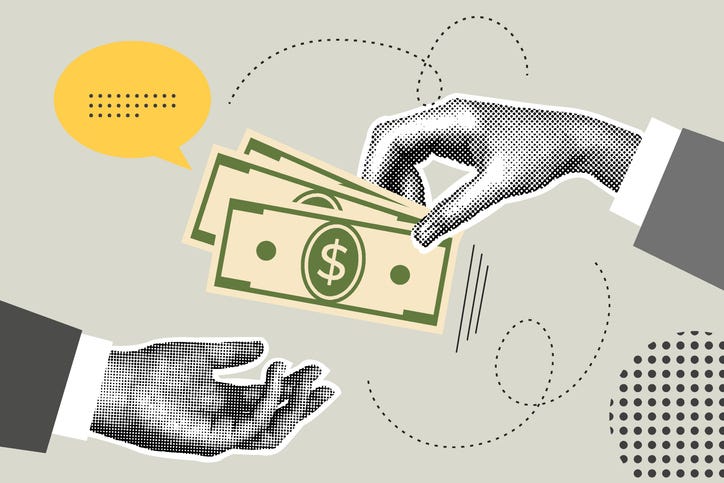
Of all the myriad insights I’ve gained during my Stupski tenure, the one that really broke my brain was: the money isn’t yours. I mean, I knew that I couldn’t spend the DAF funds on myself, but it still felt very much like my money. Here’s what I’ve come to understand, though: The tax deduction I received for charitable donations was money that I kept for myself and out of the public coffers, to the tune of roughly 30 cents for every dollar I donated. By extension, then, in taking the deduction I made an implicit pact with the American public that I would allocate the funds in the public interest. You might be thinking, “What’s the big deal? As long as it went to nonprofits in good standing, the money was benefitting the public and doing good in the world. Relax!”
The issue isn’t so much about where the money goes, but who does the deciding about where the money goes. The kind of person who is in the position to even take the deduction for charitable donations in the first place is likely wealthy to begin with, also most likely White, and more often than not inclined to direct donations to people, causes, and organizations that feel familiar and flatter their egos. And bypass those that don’t. This is how we end up with a charitable sector that reflects, more than challenges, the inequities of our broader society. Take, for example, this alarming finding by the Lilly School of Philanthropy at Indiana University: “While communities of color made up 44.3% of the U.S. population as of the 2020 Census, the Communities of Color Index shows that organizations serving communities of color received $16.0 billion in charitable contributions in 2022, accounting for 2.9% of total philanthropic giving” (emphasis mine).
It’s a complicated tension – some would say an oxymoron – unique to US philanthropy: a private steward of public resources. I’m not so sure most donors understand their role this way, and certainly most current systems and behaviors aren’t oriented towards this perspective. While I’ve come to view it as deeply problematic and inherently undemocratic, I’m also a realist living in the world that actually exists. We are not Sweden; we haven’t (yet) designed the perfect mix of capitalism and socialism that both encourages healthy free market competition and meets the basic needs of its citizens.
My Stupski Foundation role, Forward Global community, and insatiable curiosity expose me to trailblazing donors who turned their philanthropic decision-making over to the public right from the get-go and are using their capital to design new, more just, economies; foundations breaking down barriers between their organizations and their community partners to democratize resource allocation decision-making; writers who challenge the status quo, ask hard questions, and propose paths forward. It’s a small but growing movement of capital stewards who understand how the system is shaped to benefit them unfairly and are committed to designing an economy that works better for everyone.
This is the moment when all these inputs from the broader philanthropic field intersect with the world I know and love: independent film.
I’d love to say I’ve figured it all out. But that’s not where I am; lucky you, you’re witnessing thinking, learning, and reflecting in real time. When I was a high school English teacher, I loved to assign a text for my students to read at home and then come to the next class with questions. I learned more about what they understood and were thinking by the nature of the questions they asked than their answers to any of mine. So my homework for myself these days is to develop good questions. Right now I’m asking:
How does donor centrism show up in US independent film, and what are its impacts?
In the US, where filmmaking relies solely on private capital (commercial markets and philanthropy; no state funding here!), what say, if any, does “the public” have in allocating charitable resources?
If we are going to continue to have tax-subsidized funding for independent film (which we are), how should that resource be distributed, and who decides?
These questions — or better versions of them, are my companions for the next few months as I attend festivals, join new boards, dig into new initiatives, read, and write. I learn much better in collaboration than by myself, so let’s make this a group assignment! What are your questions and observations about indie film donor centrism? Please feel free to comment and share questions of your own: hello@thebacklight.org
Shout-out to Shaady Salehi, TBP Senior Fellow with an illustrious career in documentary film impact work!
This is such an honest and compelling post Maida. I love how you have always approached giving with curiosity and how important your curious mind has been to the development of the Stupski Foundation approach. Thank you for taking the time to share all of this, and give us the opportunity to learn alongside you!
This is such a thoughtful and courageous piece, Maida.
“The money isn’t yours” is a powerful frame, and I really appreciate the honesty with which you traced your own thinking rather than pretending you had arrived at a neat conclusion.
The questions at the end are compelling, and somehow beautifully right ones. I will be curious to see how and if they shift.
Beautiful work.