


A few weeks ago I shared a bit about my philanthropy journey and opened up a space to explore donor centrism in the independent film ecosystem. Today I’m diving into that burrow, rooting around in grantmaking norms and engaging in a bit of – to borrow a phrase from one of my wise Masters in Education1 professors – “imagining otherwise.” These upside-down times feel especially ripe for examining mindsets and processes developed twenty, thirty, even forty years ago and redesigning for the years ahead.
I’m sticking my neck out here, and likely asking to have my head lopped right off, by calling into question one of the most persistent practices of our sector: project-centered grantmaking. A real source of frustration that has only deepened with time. I hope that by showing how program grantmaking puts funder priorities and processes ahead of the grantees’, I’ll spark a conversation about what it would look like to adopt a more artist-centered approach. After all, that’s what we’re all here for, right?
But first, let’s take a moment to note the unique economic fragility of documentary filmmaking in the United States. Market-based, government, private, and philanthropic revenue streams open to other creative sectors – however scarce they may be – often dismiss documentary.
Arts funders say it’s too commercial
Journalism funders say it’s too unreliable
The museum world says it’s too prosaic
Art collectors say it’s too ephemeral
Justice funders say it’s too unmeasurable
Theatrical buyers say it’s too unmarketable
Film investors say there’s no ROI2
State governments exclude it from tax incentive programs
Streamers insist audiences only want true crime and celebrity doc series
Whooboy! That’s a whole lotta “no.”3 Saying “yes” are the intrepid institutions (i.e. foundations, artist support and advocacy orgs, festivals, and public media) and individuals forming a web of support for the work that does get made, primarily in the nonprofit sector. So, how resources flow in that sector really, really matters.
By the time I began funding documentary in 2013, astute nonprofit leaders had been long banging the drum about the pitfalls of project (aka program) grants. In my fifteen years in K-12 education – as a teacher, nonprofit board member, and foundation program officer – I observed that:
Funding of programs over the organization leaves critical expenses under-resourced: staff salaries, benefits, and rent, just to name a few. We call this “overhead.”
An organization lacking flexible cash to respond to emerging needs, retain staff, cover overruns, or bridge delayed reimbursements leads to revenue fragility.
Satisfying a donor’s program grant requirements often leads to mission drift and a disconnected patchwork of activities that pull the organization away from its core work.
New pilots, launches, and “innovations” are easier to narrate than ongoing work, so novelty is often rewarded over maintenance.
Short funding time horizons prompt organizations to hire temporarily, make commitments they cannot sustain, and plan around the next application cycle rather than a multi-year strategy. The final months of a grant often become a scramble to replace the funding rather than improve the work.
The administrative load can be disproportionate to a modest grant amount. Small organizations may spend significant staff and leadership time identifying opportunities, tailoring proposals, negotiating budgets, reporting, and managing separate restrictions.
Weak evaluation plans often confuse outputs with outcomes. Funders may ask for tidy outcomes on timelines that do not fit the work. Grantees can end up counting easy outputs—participants, screenings, downloads, social impressions—rather than assessing deeper outcomes such as artistic development, trust, narrative change, civic participation, or long-term community power.
With this background I’m sure you can understand why the documentary field’s proclivity for project-centered grantmaking bums me out. If project grants strain nonprofit organizations, they really do a number on independent artists. I see filmmakers spending inordinate time and brain cells writing bespoke grant applications (often for modest dollar potential), in spite of the funders crafting the Documentary Core Application in a valiant attempt to ease the burden; “one and done” film grants meaning a $50,000 award during year one is it – foreclosing on the possibility for multi-year funding for projects that often take three or more years to complete; grant restrictions mandating funds cover only production expenses so the overhead of living a life must be raised elsewhere; and accomplished filmmakers starting back at square one with each new film, applying for the same highly competitive development money as all the emerging artists under the sun.
The call is coming from inside the house on this one. I’ve made plenty of project grants in my day and I have the EP credits to show for it. Especially when I was new, I just didn’t see any other way to support the work: filmmakers presented projects on stage at Good Pitch and Sundance Catalyst, producers emailed project pitch decks, fiscal sponsorship arrangements set up projects to receive grant support. Along the way, I instituted a few practices meant to mitigate some of the harms of project-based support; for example, I reviewed pre-existing rather than required specific materials to reduce the administrative load; sent the money then largely got out of the way to allow the creative process to naturally unfold, with an open door policy to future asks for contributions of sweat equity; stretched to make meaningful-level grants ($50,000 minimum) to alleviate a bit of fundraising pressure; and, by the end when I was saying yes to films I knew would take years to complete, I offered multi-year support (including a $50,000 “premiere guarantee” to stave off the inevitable, “OMG we got into X festival and are broke… help!” request).
All along, though, I knew I was participating in a practice that, at best, does not lead to artist sustainability and, at worst, impedes it.
My friends and acquaintances who work in documentary funding are probably feeling a bit prickly right about now. So it’s important that I take a moment to address them directly. My critique of project support is in no way a personal attack on all you wonderful people. I deeply value your camaraderie and thought partnership, and your commitment to the field is a constant source of inspiration. You truly love the artists and the work they make, and you move mountains in support of this art form. You make miracles happen every single day. We wouldn’t have any of it without you! I also know that working within organizational constraints is a thing; and history, norms, practices, cultures, management, and boards are real – and often beyond the scope of your control to change. I have the immense privilege of working independently, with one foot in that world and the other out, so I can stand out here and be all sanctimonious. My goal is to not to call out but, rather, to call in; to use my position to start a conversation that could lead to an exciting, more sustaining future we create together.
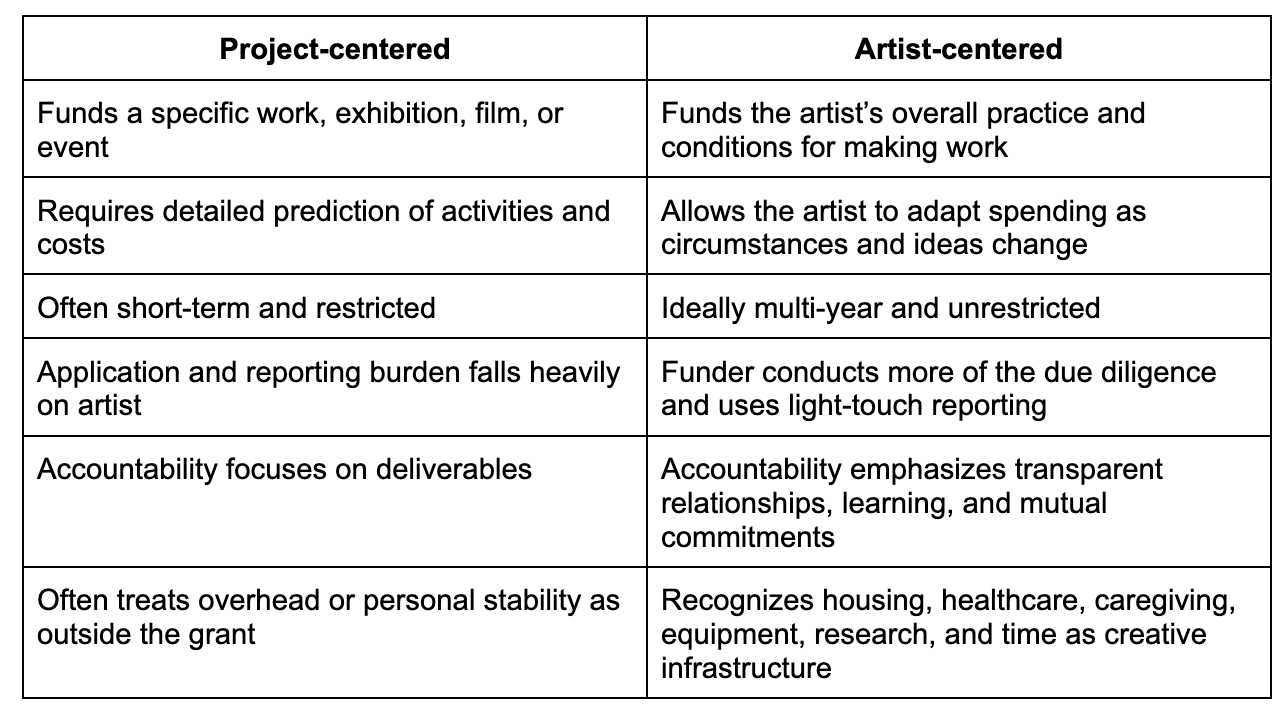
If project-centered grantmaking leaves a lot to be desired, then what’s our alternative? For organizations, it’s general operating support. For individual creatives, it’s artist-centered support.
A side-by-side comparison offers an overview of some key differences:
We are living in a time of unprecedented wealth accumulation, with a tsunami of generational wealth transfer on the horizon. What kind of funding practices do we want to demonstrate to these rich folks we invite into our beautiful, creative, and passion-filled world? What would it look like to create onramps for these new funders – the future Maidas – to allocate significant resources to philanthropic practices that are truly enduring for the artist? Here’s a start: a constellation of MacArthur Fellow-esque programs both massive and modest, where trust – along with capital – is transferred from wealth holder to creative risk-taker, storyteller, documentor. How amazing would that be?
I do not have all the answers, and I sure won’t figure this out alone. Feel like imagining otherwise with me? I’d love to hear from you: maida@thebacklight.org.
Go Mills College! I mean, Northeastern University Oakland
Meaning, not commercial enough; so there, you arts funders, take that!
For now. I do think there’s an opportunity for some fun comms work to be done, busting these myths and bringing more resources to the field.
This is so needed generally in the entire so-called “indie” field, not just nonfiction. The lack of it is why there is at least 7 years (!) between films for most makers. Nonfiction makers can at least multitask projects in a way others rarely can.
I hear echoes of this at every film financing panel. Clearly the current funding mechanisms aren't working for most indie filmmakers. I'm a big advocate of trust based philanthropy and how more flexible funding structures can help creatives lead better lives and produce higher quality work. I think the missing piece is more examples of this approach working -- not just in terms of festival awards or distribution stats, but also the real-world impact on policies and culture.